The Exercise-Stress Paradox: Why ‘just do it’ is not so simple…

When Saturday rolls around, Ade (my other half) and I head to our local Park Run. It’s a reasonably new thing, but since taking up running it is something that is very much a ritual to our Saturday mornings. However, (at the time I started writing this) the route was covered in ice, it was cancelled. Off to the gym we went.

As always, I’m drawing on personal experience, and today’s Ponder (a draft post that has sat hidden from the world) explores my relationship with exercise, and why ‘just doing exercise’ is not that simple. Before I go on, it’s important to acknowledge that I am going to make generalisations here, and I appreciate that I am only one opinion, but if past blogs are anything to go by, I’m sure there will be people out there who relate.

Here are some questions to kick us off. Questions that I feel highlight the many barriers that can prevent (and have prevented me in the past) from doing any exercise. Do any of these prevent you? As you’re reading this, feel free to make your own notes! For transparency, I’ve included my own responses in italics.

  1. Do you now, or have you ever actively enjoyed exercise?
    I never used to enjoy it. But I do now. However, getting started can often be the biggest hurdle for me. If I give myself too much time to think about it, I have been known in the past to talk myself out of getting it done.
  2. Did you enjoy PE (Physical Education) in school?
    No. I hated it. Many a note was written excusing me from it. I did try my best though. It just wasn’t my subject.
  3. How many of you reading have been forced into doing exercise?
    Yes. In PE. Cross Country running was the worst. As was football and Hockey.
  4. Have you had a particularly negative experience directly associated with exercise?
    Yes. Mostly from doing PE. Being out of breath, having that horrible dryness deep my throat and not being able to breathe, and also just not being good at sports made me embarrassed by my efforts, despite trying my best.
  5. Have you ever, or do you currently feel intimidated, overwhelmed, .or scared, by exercise?
    For sure. Both past and present. The gym can be an intimidating place. Running in public is a vulnerable place. I think gym cultures are changing, but internal biases and judgement still exists. I’ve been working hard to quiet the fear of what other people think. I’m definitely getting better at giving less of a damn.

Now, this isn’t a dis to any PE teachers. My PE teachers were lovely, and they definitely had their work cut out for them. But the big difference is they liked exercise in the first place. They have a passion for physical exertion that many people just don’t have.

Yet, it’s one of the best stress relievers, and mood boosters there is.

Here’s where the challenge lies.

Its common knowledge that exercise is beneficial. We know that it will make us feel better.

But for many, that knowledge is not enough to inspire action.

Especially when the thought of exercising is overwhelming and stressful.

This is the Exercise-Stress Paradox.

Heisz et al (2021)
Millard (2022)

I think about my relationship with exercise, and this pretty much hits the nail on the head. Although it has improved somewhat in this last year. However, there are still loud thoughts that are battled with.

I’m more active now that I think I’ve ever been, so I’ve been pondering as to why is this time round so different? What has changed? Here’s what I’ve concluded.

Firstly, in some respects, I’m a different person than I was when I was at school/college/uni. I’m older and marginally wiser. In my twenties, I wanted to be fit, but the reality was I didn’t want it enough. And let’s face it, in our twenties we feel invincible! Late nights, early mornings, eating everything in sight, and drinking like there’s no tomorrow. There was always something more pressing to do that exercise, and it always felt like a chore. I also didn’t really have an appreciation for the benefits of exercise and movement. However, now that I’m in my thirties there is a new awareness and affinity with being physically active. I think this is down to a few things. I’m not getting any younger. Don’t get me wrong, I don’t consider myself to be old, but I do notice that things creak more than they have in the past and aches and pains are daily squatters. Additionally, I don’t want to be someone who gets to retirement and isn’t actually fit enough to enjoy it. So that is my pledge to myself; to continue to develop a positive relationship with my body and what it can do. Celebrate the successes big and small and use each day as a steppingstone to get that bit fitter, healthier, and stronger. Even on the days I don’t want to, and rest assured there are plenty. But here’s what I’ve learned…

  • I rarely regret the exercise and movement I do. Whether it’s dragging my ass out of bed at 6am for a run or trudging out the door for a post dinner stroll. There are very few occasions when I regret getting out and getting my body moving.
  • Every time I move is a win. Whether it’s five minutes rolling about stretching on the floor – for flexible people it’s called yoga – for me it’s called Yoga. Did you think I was going to be self-deprecating there?!
  • Even on the days when I’m beating myself up (I’m accomplished at this, and I’m working on being kinder to myself), there is something positive to be taken from it. That’s not to say I’m denying myself or invalidating what I feel. But in challenging my perspective, I’ve found there is more that can be learned. Just the other day, I’d come in from a morning run, and was beating myself up because I struggled to sustain my mile pace for two minutes. The reality, and indeed bigger picture, was that although I hadn’t lived up to my expectations for doing the two minutes, I did manage interval training with only thirty seconds of rest time. A first in my training. In addition to that, I’d completed a mile (run/walking intervals) in twelve and a half minutes. Meaning I’m on track to beat my previous 5K running time pre-breakdown. PLUS, when I think about it, the average pace for my two minutes was six minutes and fifty-six seconds. So, if I wanted to complete a mile run at that pace, I’d be running for nearly seven minutes. I did two, therefore I’m a quarter of the way there!! See – Change the perspective.

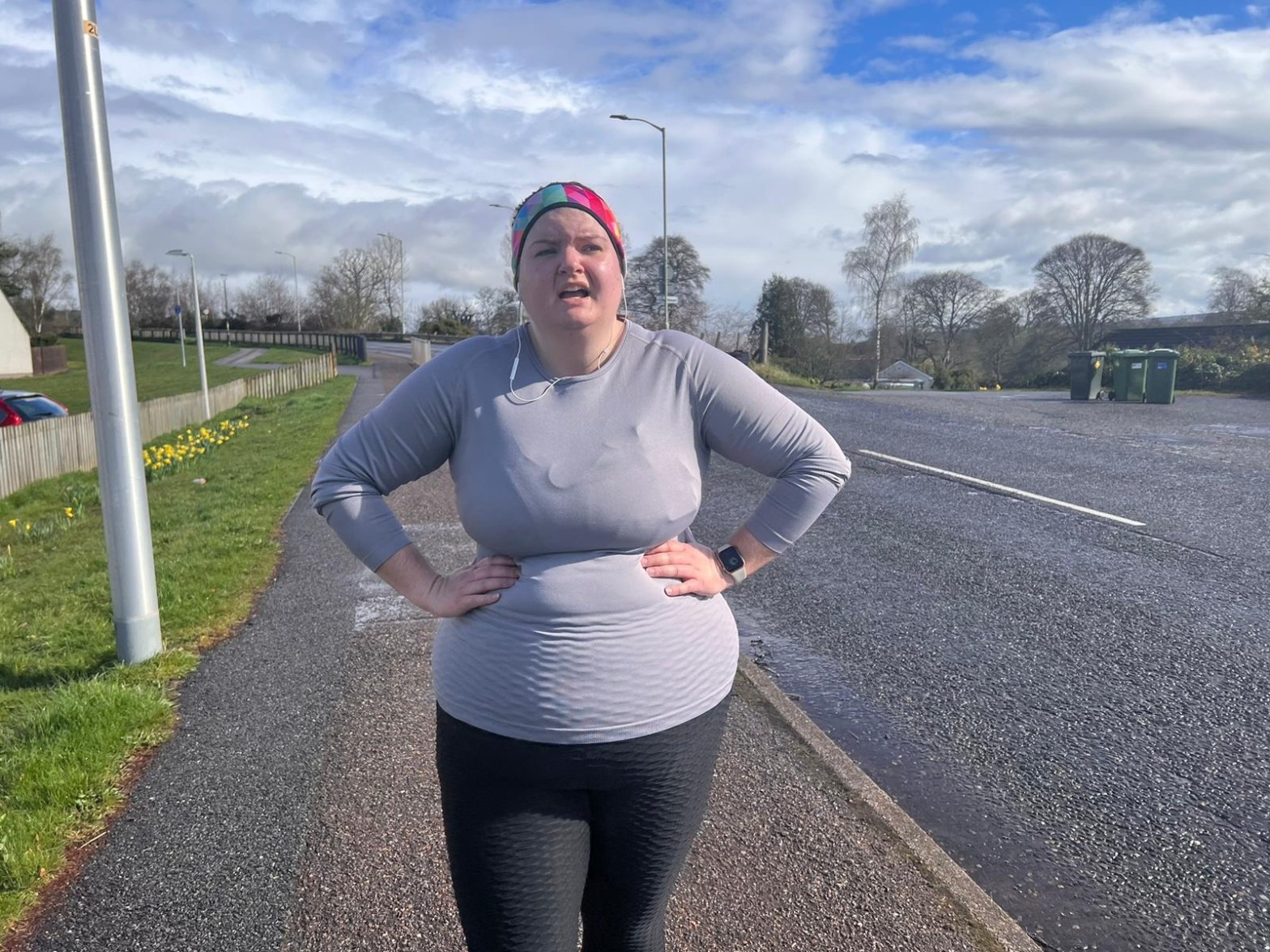
I guess what I’m trying to say is that it’s worth it. To push past the fear, the anxiety and the worry of exercising and moving. It’s cliche to say, but we do only have one life, and I’m not going to spend any of mine worrying about what someone may or may not think about me as I thunder down the pavement with my bright red face and puffed out cheeks. There’s no going back now, and on the days I can move, I’m moving!

I’m doing this for me, past me, present me, and future me.
How about it? Five minutes of movement is still five minutes more movement in your life than yesterday. Choose you movement – I’m rooting for you! Let me know how you get on in the comments, one day at a time.

This has been a SmartPonders.
Thanks for reading. x

Bibliography

Heisz, J., Fenesi, B., Ogrodnik, M., Nicholson, E., Marashi, M.Y. (2021) A mental health paradox: Mental health was both a motivator and barrier to physical activity during the COVID-19 pandemic [online]. Available from <https://journals.plos.org/plosone/article?id=10.1371/journal.pone.0239244>

Millard, E., (2022) What Is the Exercise-Stress Paradox, and Could It Be Affecting You? [online]. Available from <https://www.bicycling.com/news/a36364711/exercise-stress-paradox-study/>

What’s your evidence? A strategy to challenge your thinking

Content Warning: Mental Health, PTSD, thought spirals, suicidal thoughts, negative self-talk

I’m sure there are many of us out there who have been met with some pretty scary and potentially damaging thoughts. Thoughts that can catch you off guard, thoughts that come from nowhere, and thoughts that don’t feel like they have come from you. Those are certainly experiences that I’ve had when my PTSD or anxiety has been triggered. I want to share some of that today, and also highlight a super strategy that is a necessity in my mental health toolkit. As with all my blogs I’m sharing from my experience and know that experiences vary so much from person to person. As always, I hope those reading can take something from this.

For reference, ‘spiralling’ or a ‘downward spiral’ is defined as a series of events, thoughts, or feelings that gain in momentum contributing to a cycle of negativity (Kurland 2018). It can also occur in the opposite fashion for an upward spiral, where there is momentum gained through positive occurrences. For the purposes of the blog, we’ll be focused on the downward spiral.

From my experience, downwards spirals are hellish. Thoughts that have told mez, “I’m not good enough”, thoughts that have said, “nothing I’m feeling is real”, thoughts that have said, “I’m worthless”, thoughts that have said, “I’m an imposter and people will find out.” Thoughts that said, “I don’t belong here.” Thoughts that said, “I could very easily veer into oncoming traffic.” For clarity, I am not suicidal, and have not felt suicidal at any point during my breakdown or recovery. However, that doesn’t invalidate the fact that I had that thought. I’ll be honest, it terrified me. Mostly because it felt so out of character, and that it came from nowhere. I was just driving home, I wasn’t feeling stressed, I’d had a good day. It caught me so off-guard that I had a panic attack. Our thoughts have immense power. Both good and bad. When I brought it up with my therapist, she advised that I acknowledge the thought – I hear it, I question it, and then I let it leave. For me, I like to think of thoughts as visitors in my house. I’m under no obligation to permit them to stay. Easier said than done though.

When I’m in that downward spiral of negative self-talk, there usually appears a ‘moment of opportunity’. This is when there is a slight dismissal of a thought. Or when there is a thought that fights to contradict the negative thought. A moment in my thinking where the negativity dissipates – just for a moment. However, sometimes I’m not aware enough of that opportunity and this is when having someone I trust is really beneficial. At some point in my thinking, I put the strategy into place.

On the surface the strategy appears pretty simple. It’s one question.

“What is my evidence?”

Super Strategy!

The reality of using it, however, is not so simple. It takes practice so please keep that in mind. If this is a new strategy to you, I’d suggest you find someone you can trust to help support you and ask the question for you when you feel you are spiralling. It can be easier for a friend or family member to spot you on a downward spiral than yourself. I acknowledge that for some, being in that spiral can be so debilitating that the mere thought of being able to ask this question, let alone answer it feels impossible. If that is you and you don’t have a support network, or someone you trust to ask you that question, let me.

See that thought you’re having? What is the evidence you have for believing that thought? Where is the evidence that backs it up? Just because you think it, doesn’t mean you have to listen.

Your thoughts are not always true.

Let me share some examples of what happens in practice.

Thought:
“There is nothing wrong with me, I’m fine, why am I just not back at work?”

Question:
“What’s the evidence?” Meaning what evidence do I have to support (or deny!) this claim.

Answer:
I actually have plenty, I have a doctor’s note. I have therapy sessions, I have my journal entries, I have the tears I have cried, the memory loss, It’s all there. All evidence of me being unwell.

In this instance, it’s about acknowledging the thoughts and the feelings – not denying them. Whilst also acknowledging that there is rational, tangible evidence to disrepute this thought. What was happening in this moment was grounded in insecurity. I had gone from working full time, being functional, being productive, to suddenly grounding to a halt. I didn’t know how to just be, and to heal, and so instead, I started to berate myself. I created this pressure on myself to just be better. Unpacking that I realised the reason I was creating this pressure to get back to work, was that I’d created a false reality where I work well under pressure. The reality is that I had adapted so much to that way of working that I’d accepted it to be true. When in truth it’s not the case given the preference. My subconscious was trying to be helpful by tapping into the ‘reality’ that ‘I work best under pressure.’

How many of you can relate to this?

How many times have you told yourself you’re fine, and to ‘just get on with it’ when in reality you’re not fine?

How many of you have lost track of what ‘fine’ really is?

Share your thoughts – I’d love to hear them!

Unfortunately, I don’t have the answers, but I do have a curiosity and a drive to be having these conversations. We may not actually be ‘fine’, but that’s ok. We can and will get there. Maybe even beyond, to a point when we can say “I’m good” and mean it.

Until then, let’s keep challenging those thoughts, and wanting more for ourselves.

This has been a SmartPonders
Thanks for reading.

Steph x

Bibliography
Kurland, B. (2018) ‘Reversing the Downward Spiral’ Psychology Today [online]. Available from <https://www.psychologytoday.com/us/blog/the-well-being-toolkit/201809/reversing-the-downward-spiral&gt;

Beautiful coincidence or something more?

Having recently enjoyed an episode from the Mel Robbin’s Podcast on Synchronicity, it’s given me plenty to think about. So, buckle up because that’s what this blog is going to be – a stream of consciousness as I navigate what synchronicity is, and where it comes from, and what relevance it has in my life and think of some examples. It totally blew my mind, because I’ve definitely experienced it before but just never knew its name! As always, I hope you take something from the ponder and if this one isn’t for you, thank you for your time all the same. I realise it’s going to get pretty deep and also not be everyone’s cup of tea as I tread the waters of spirituality, chaos, and quantum mechanics.

I think I’ve always considered myself to be a spiritual person. What I mean by that is I believe there is something more to our lives and that we’re connected to something bigger than ourselves. For me that’s the universe and energies. I believe there are signs, symbols, and reminders that get sent to us from the universe when we need them, or to confirm to us we’re on the path we’re supposed to be on. It’s like a wee wink from Mother Earth, that says “you’re doing grand.” Now, I’m not a particularly religious person though. I don’t believe in God as such. But I do believe there is a higher power/energy. This belief appears to be getting stronger as I get older. That’s the context from which I’m writing anyway. So, let’s get into it…

As suggested by the title, today’s blog does some digging into this idea that the universe sends wee signs to us as a way to guide us and to confirm we’re on the right “path.” I guess I’m more curious about others’ experiences in this, and if you’d be willing to share, I’d love that!

To begin with, we need to define what synchronicity is. According to Dr Mike Hyman, the phenomenon is defined as ‘a meaningful coincidence – an event that on the outside speaks to something on the inside – as opposed to a random occurrence’ (Hyman 2022). Within quantum physics (the study of matter, with a focus on probability over certainties), and quantum entanglement (study of synchronicity in matter) there is research that shows synchronicity exists in the physical universe, that particles can impact each other even when they are light years away.

A concept in psychology, it was first introduced by Carl Jung in the 1950s. It was (and in some ways still is) a bit of an out there theory. In quantum physics, it is accepted that reality is shaped by consciousness. Meaning there is no such thing as one reality. If we go to the same concert, we’ll have different experiences that ultimately shape our own realities of the event. Synchronicities are part of this train of thought. Jung argued that synchronicity is when an occurrence happens that has a sign, symbol or meaning attached to it, but that the event on its own also has meaning. It’s not just a case of something happens and we interpret a meaning to it. The event will have a relation to something else going on, as well as a meaning of its own. It feels more than just a coincidence. For example, on the anniversary of a loved one passing, you hear their song on the radio. The song has meaning on its own, but also then holds a meaning (comfort, love etc) to you in the moment you hear it. Or you are thinking about someone you haven’t heard from in ages that you miss, and they suddenly get in touch, and you’re grateful that they have. These are examples of synchronicity. There is meaning for you in the occurrence. It’s worth noting that the synchronicity doesn’t always happen over short periods of time. They may appear over years like little puzzle pieces.

Can you think of a time in your life where you’ve experienced synchronicity?

As always, feel free to share!

For me, one of the biggest examples I think of in my life is around my partner Ade. Back in 2017 when I got the job at the university, my dad tagged me in a picture on Facebook of the campus, a beautiful 360 picture with the building bathed in light from Beautiful Inverness. You can see the very thing here. I gave it a like of course. 360 images were pretty new to me, so it was an instant hit. Ade and I didn’t know each other then. That was shared with me in the Aug of 2017.

Fast forward to late September of the same year. I’ve relocated to Inverness and like any young, free, and single gal I download tinder (again). I get chatting to this guy – Ade. It’s refreshing. It’s actual conversations and not a d*ck pic in sight! In actual fact at one point, he sent me a picture of a server unit with all the cables neatly organised as an example of something sexy. We chatted for about 6 weeks before we arranged to go for a date. He was on shift work which made it a bit of a challenge and I was finishing up work in Edinburgh as well as working 9-5 during the week. Anyway, we compromised, and he came down to Edinburgh with me on a day trip (I was working on a show). I know. Who goes on a date with someone they don’t know that includes 6hrs in a car! Don’t worry, I’d done my due diligence… I’d checked out his Facebook. Turns out we had a friend in common. Of all people Ade could be pals with… my dad. Naturally, I subtly asked dad the skinny on Ade. Nice guy, sound. That was enough for me. Ade and I have been together 5years now and my dad still highlights that he was dad’s bestie first.

It’s funny because when I moved up it was a maternity contract I’d taken. Claire, one of my Edinburgh besties said to me, “you’ll never come back to Edinburgh. You’ll fall in love and end up settling there.” I laughed and rolled my eyes.

Ade and I had been going out for about a month or so when he tells me he used to have his own photography business, mainly doing functions, but that he enjoyed taking pictures of highland landscapes and landmarks. The campus being a good spot for photos. He even told me about the Facebook group he started. Yup. Beautiful Inverness.

Is it a coincidence? Maybe. Do I think it’s something more? Yes. But that’s just it. We get to decide what has meaning for us. What may seem like small moments of nothing, can be huge moments of everything for someone else. For me, that moment felt like a revelation. Like somehow Ade and I are meant to be in each other’s lives.

What’s the point in me chatting about synchronicity? What benefit can it have?

  • Be open to coincidences: It can create an opportunity to be more open with the world. There is a belief that our souls attract people, places, and events that ultimately support our growth and development. We grow. We develop. Who doesn’t want that?!
  • Become intentional: The more aware you are of these synchronicities; the more agency you have in your life and the choices you can make. See the signs, acknowledge the feeling, and walk towards the sign.
  • Re-train your brain: what you think and what you feel broadcasts an energy. Within Quantum theory and neuroscience, each thought has an electrical charge, and each feeling has a magnetic one. When we change our mindset, we can change our lives. (Dispenza 2022).

For me, it’s about seeing the magic in the everyday. I take comfort in that. And let’s face it, with the world the way it is at the moment, so many of us need a little comfort in our lives.

In summary, synchronicities are events that you are meant to notice. They are meaningful coincidences. Not just random occurrences, but genuine anomalies and experiences that feel improbable. They make you feel something; empowered, comforted, supported, guided etc. for me, I welcome them. The last 11 weeks have been chaotic and unlike me, and yet, there is a sense to it all. A sense I’m not getting into right now, but it feels like everything that has happened has all happened for a reason, and it’s all the foundations and building blocks for something bigger that’s coming. Who knows?! Maybe it’s all in my head and I’m losing the plot. But for now, I’m interested to see how it all plays out.

Try it out. Scavenge for those synchronicities! And if you want to share when you find them, I’d be happy to listen!

This has been a SmartPonders.

Thanks for reading!

Steph x

Bibliography

The Trick the Treadmill Played…

Taking a slightly more upbeat, but still honest, discussion, this blog was inspired by a recent gym visit. There was something quite profound learned there.

If you’re a regular reader, you’ll know I’m having a time of it at the moment with my mental health. If you’re new here – hello! I’d also suggest you read the two posts prior to this one for context.

As part of my recovery, I’ve been going back to basics, digging deep into my existing toolkit, and indeed adding to it with new tools and resources along the way. I think back to my recovery period with my ME the first time (and worst time!) round, CBT was fundamental. Things like setting small goals for the week, looking for opportunities to change my mood or lift it even if for a moment. Whilst I’m very much using these, and others, the one that makes the biggest difference – which many will hate to hear, myself included – is exercise. In some ways I find it a dirty word stemming from embarrassing and painful PE classes in school. Always being the last one to finish, nearly dying during cross country, and countless attempts to get a note from mum and dad. I hated it. Tried my best but hated it all the same.

However, now that I’m in my thirties there is a heavy desire to take better care of myself – mind, body, and soul. Earlier in the year I started the couch to 5k programme. Weighing in at 20.5 stone it was daunting, but something that I had an almost out of place determination to do. I know. I’m as surprised as you. By October I’d completed my first 5k race and had lost 2stone in the process. But… then the episode happened, and it’s all came to a screeching halt for eight weeks.

I’m now in a place where I’m trying to regain what has been lost fitness wise, (as well as regaining a functional brain!) which is what this ponder is about. On Monday I’d spent the day pottering about the house drinking cups of tea and working through the small goals I’d set for the day. When Ade returned from work in the evening, he suggested we go to the gym. With little time to think, and knowing I hadn’t done any exercise that day, I said yes, and quickly got my things together.

Regardless, I kept pushing through, thinking “well maybe as I settle into the run, things will be better.” In the voice of Morgan Freeman “things did not get better.” But I kept pushing. My legs were killing, my breathing was heavy, there were even palpitations thrown in. The thought of a heart attack did cross my mind. By this point I was approaching the thirty-minute mark, and quite frankly had had enough of trying to run. So, I switched to a walk. I was 1.7miles in.

On the way to the gym, I’d set myself an aim – to hit the treadmill and to run a 5k. Spoiler – I did not run the 5k. I did complete a 5k, but did intervals of 60sec run, 90sec walk. Following my five minute warm up, I knocked the speed up to six and off I went. Except something wasn’t right. It was incredibly difficult, and it felt like my body was just not willing. My pacing is usually somewhere between six to eight kph dependant on the day, so when I was struggling with it today, I felt disheartened. Really disheartened. Even on my most rubbish of run days I’ve still managed to at least run for one minute. Cue the spiral of negative self-talk. Something along the lines of “I’ll never run again, I may as well just give up. This is awful. Why does my body hate me…” Familiar to many, I’m sure.

I was a sweaty, aching, dejected mess. It’s funny how we can spiral when things don’t go to plan. Despite my negative Nancy shouting through her megaphone, I was trying to still be upbeat – I made it to the gym, I tried my best. Looking for the things to celebrate. I looked at the screen again.

I paused.

I was 1.7miles in.

Miles.

MILES. NOT KILOMETRES!!

On hitting this revelation, I realised that the “6” speed on the treadmill was, say it with me – miles per hour. And not the kilometres per hour that I am accustomed to running, or thought I was running. The reality was I was walking 5.5 miles per hour and running between 9.5 and 10 miles per hour in the intervals!! In comparison my usual intervals are 5.5-6 (kph) and 8kph for the run. No wonder my body was struggling. It was trying to run a whole two kilometres faster than it usually does!!

In one tiny moment I realised my worst run had suddenly become one of my best, reaching speeds I dream of eventually being consistent with. By the end of the workout, I completed the full three miles, with almost two miles of that being the speedy intervals.

The point of this blog is to remind myself and you reading of the following…

  • It’s easy to jump to conclusions before we have all the facts.
  • It’s often a default to listen to the negative self-talk over the positive. Keeping this in check is important. I think of the things I would say to a friend who had just told me they had a crap run. I’d say things like “a run is still a run” or “you still made it to the gym. You tried your best”. I’m working on treating myself like how I treat my friends.
  • I rarely regret doing exercise. It might be a mission to get started but nine times out of ten I’ll feel infinitely better for it. Therefore the summary is exercise must be a daily priority.

In conclusion, effort is still effort. Achievement is still achievement and I think it’s so easy to knock ourselves down when we definitely don’t deserve it! And remember to challenge your own thinking – your brain is pretty adept at lying to you. Mine is anyway.

As always, I hope you’re doing ok, and I hope something in this post resonates with you.

This has been a SmartPonders.
Thanks for reading.

Steph x

When my brain don’t work like it used to before, and I can’t even spell my name…

Content Warning: mental health, intrusive thoughts, anxiety, ptsd, burnout.

This is week eight of my recovery journey. I’ve been learning to slow down, to feel my feelings, to release them, whilst also accepting that I’m not mentally or emotionally where I need to be yet. And that’s ok.

The blog that follows (the stuff in italics) was written in the moment, live so to speak, as I tried to function. I wanted to record it as best I could to try make sense of it with a clearer head. The italics have not been edited. This is an example of a bad day for me. I am working on not getting frustrated with myself when days like these arise, whilst reminding myself it’s all part of the process. But that’s hard because I set high expectations on myself which is not always a good thing. Pondering following the italicised record.

23rd November 2022

I often find myself wandering around the house. I feel like I want to do “something” but at the same time feel an incapacitation to follow through.

My bedroom is a riot with clean clothes in piles, waiting to be put away. The kitchen has dishes to be put into the dishwasher. There is plenty house work I could do.

But I want to make bread.

But to make bread I need to clean the kitchen.

And to clean the kitchen I have to get dressed. My oodie’s sleeves are too long and get in the way.

But getting dressed feels like a mission. I know I just need to Chuck on a pair of leggings and a top, but I feel, I am, dysfunctional.

I have a craving for sponge. I’ve looked up a simple recipe for queen cakes. But I need milk. So I need to go to the shop. I now sit and weigh out how much I want queen cakes against how much I don’t want to go to the shop. I try to probe why I don’t want to go to the shop but can find no logical reason. I’m still in my pjs and oodie so again, would need to get dressed, but if i’m going to get dressed anyway to make bread then it shouldn’t matter as it’s going to happen regardless. Right?

Im sitting on the bed typing this between moments of zoning out and empty head. It’s like my brain is short-circuiting. Like it just stops. Resets. Then tries to work. And it does to a point, but I’m a quarter of the brain from before. That’s probably being generous. It took me 10minutes the other day to spell my name. I wish I was joking.

My sister appears. She looks quizzically at me and asks if i’m ok. I tell her i’m writing a stream of consciousness. I guess I think that by recording moments like these (and journalling), I can look back and see how far I’ve come when I’m further down recovery road, and also because they are honest insights into what I think and feel. and also because they feel fucking mental.

There is so much about recovery that’s hard. One of those things is the feeling that I’m so far away from “me”. The functional, positive, outgoing, me. The me that would jump out of bed in the morning for a run, or yoga, then get ready for work, before spending the day teaching and learning. That all feels miles away from where I am at the moment.

The other things I find challenging are

  • There’s no time limit on how long this will take.
  • Being honest with myself and accepting I’m not ok.
  • Letting people show up for me. I’m not used to being vulnerable and having to lean or be supported by others.
  • The negative self talk. It’s absolutely true that if a friend of mine was going through what I am, I wouldn’t dream of saying things like “you’re being dramatic”, “just get on with it”, “there’s nothing wrong with you”. And yet, I hear these and have to quiet these comments regularly and I know they aren’t true, but I still hear them.

I did some work around this with my therapist and came to the conclusion that the voice in my head that puts pressure on me to be fine and back to work thinks it’s being helpful because I’ve become so used to working in a heightened state of stress and pressure that I’ve created a false reality that I work best under pressure. When actually that’s not true. That was a big revelation.

Regardless of the challenges, I do know with complete certainty that I’ll get through this and out the other side stronger and more at peace than I’ve ever been. That keeps me going. For now I’m continuing to take it a day at a time. Setting mini targets each day, journalling, and doing small things to help me find my happy moments, or even a momentary boost on the lower days.

True life is lived when tiny changes occur.

Leo Tolstoy

Always taking it one day at a time. Sending out love and solidarity to anyone else in the same boat. It sucks, but it only sucks for now.

This has been a SmartPonders.

Thanks for reading.

Steph x

Trudging through treacle and treading a tightrope.

CW: Mental Health, PTSD, Depression, Anxiety, Chronic Illness

As I write this, I’m in two minds whether I’ll actually post it. If you’re reading this, obviously I have.

For those of you that follow the ponders, you’ll know I’ve not been all that great lately. I’m currently signed off from my work, struggling with both my mental and physical health. This is still very much an ongoing, day-at-a-time, process, which is what todays ponder is about. In some ways it feels like I have so much I want to say, to get out of my head and “down on paper” and in other ways I feel like I have nothing to say at all. There’s an emptiness. For whatever reason, writing things down, typing things out, and trying to release them feels somewhat helpful, cathartic maybe. As with all the posts I’ve written, it’s never about pity, or woe-is-me. It’s about sharing my experience. It’s about being open and creating spaces to have authentic and at times difficult conversations about mental illness. It’s about reminding others out there (and indeed myself) that we’re not alone.

This is my fourth week signed off. The doctor wrote depression on the script. It’s been a long time since I’ve been in a place like this. In fact, I’m not entirely sure I’ve ever been as bad as this, and that in and of itself is something I’m having difficulty accepting. The best way to describe it is as the title suggests. I’m either trudging through what feels like treacle or treading a tightrope. Except I can’t see how I got on the tightrope, nor can I see where it ends. It’s also windy and my balance is the human equivalent of a Weeble. The positive is that at least Weeble’s don’t fall down.

The peculiarity and frustrations of depression and anxiety

If you’ve experienced depression and/or anxiety, I’m sure many of the things I’m about to say will resonate. Again though, this is just my experience so far as I try to make sense of it all. Throughout my life I’ve had depressive episodes. Thankfully, not all that often, but valid all the same. Usually, it is anxiety that is my dominant demon. She’s been around for years, in various iterations, but the majority of the time I kick her out of the way and push through. However, this time, she’s kicking back, and she’s brought her pals. Low mood, lack of interest in anything, zoning out, empty head, but also loud noisy head, exhaustion, insomnia, comfort eating, not eating, and questioning whether any of it is real, and the tears. I know it is real, because I wouldn’t be having a mental breakdown in the middle of Starbucks for what appears to be no reason if it wasn’t real.

I’ve experienced what I would describe as mania. Spirals where I feel out of control of my thoughts and feelings, to the point it has scared me. There are also physical symptoms; pain both in the sense of acute pain where parts of my body radiate heat as well as a generalised ache in the entirety of my body, headaches, cough, dodgy throat, palpitations, difficulty breathing. You get the gist. I’m aware though that some, all, none, of this is related to my ME (and post-covid the second). And I think that’s a challenge. ME relapses at this point for me are an Olympic sport and I’m holding the gold medal. But this mental health episode feels beyond what I’ve experienced before.

When I’m at home, it’s my safe space, and most of the time, I feel somewhat fine. Maybe ‘fine’ isn’t the word. Neutral is probably more apt, or numb. Well, I feel what I perceive to be the physical ME symptoms mentioned above, but mentally I feel ok. But not ok. I think this is part of the problem, I’ve set the bar so high as to what ‘ok’ actually feels like, that the reality is I’m pretty far away from that. Let’s face it, when we’re ok, and we’re mentally well, we’re not having emotional outbursts over Rhianna’s new single in the car, nor are we greeting over being asked how we are or reaching for the tissues because the astronaut in the film we’re watching has just come into contact with a solar flare and is doomed to die. Right now, I’m not ok. And that is ok. This will take time, and I need to be ok with that too and not be frustrated with myself that I’m not better yet. I’m working on that part. It will take as long as it takes.

Perceived or anticipated judgement from others

Why is it we feel guilty for taking time off when it’s something relating to our mental health? Why are we made to feel ashamed when we try to actively remain connected to the real world, and the people in it? Trust me, it would be so, so easy to give in, to stay in bed all day, to retreat from the world. I’m fighting that every day. Just because I’m signed off from work, does not mean I’m signed off from life. Imagine my surprise when I psyched myself up to return to the building (as a trial for my originally planned return to work the following week) to observe a rehearsal in the evening. It was going to be quiet, and I was going to be with supportive people, and it wasn’t going to be too demanding emotionally, mentally, or physically. It was the first time being back in the building since my PTSD episode begun. My intention was to create a new positive association with work to prepare to return.
I genuinely thought I’d be ok returning to the building, but I wasn’t. I’d managed to overcome the panic attack in the car park – which felt like crashing face first into a wall – only to be met with, “if you’re signed off, I can’t let you in. You Shouldn’t be here if you’re signed off.” I did get into the space eventually, but the reason I share that is because there will always be people who will judge. There will always be people who don’t understand.

This may be a surprise to learn but depression is not [always] lying curled up and crying all the time. That definitely makes an appearance, but brave faces can and are worn. There’s a saying… “don’t judge someone until you’ve walked a mile in their shoes.” Any time that I have been in a recovery there are three principles that I return to.

  1. Where possible move. Whether that’s walking, stretching, just moving around the house.
  2. Remain connected. Fight the urge to run away. This is why I’m opening up about all this because I know there will be others who want to conceal what they are going through and also want to run away.
    Note though, no one says you have to talk about what you’re going through. But I know from my experience, talking about it does help. It’s better to release the thoughts and feelings either aloud or writing it down, than keeping it stored in the body and mind.
  3. Find something that you like doing, or previously enjoyed doing, and set time in your week to do that. There will be times you definitely don’t want to do it but make that promise to yourself that you will try. For me, that’s what it is about – trying. For many depression is not necessarily living every minute of the day in despair, although for me there are days like that. There are still moments where I laugh, where I feel lighter, and when I feel (somewhat) function. However, there is a cloud, a dread, or an anxiety that follows. Part of the fight is trusting the process, feelings the feels, and looking for those moments of achievement and gratitude regardless of how small those moments are.

If you’re lucky enough not to have experience of depression and anxiety, please don’t contribute to the challenges that others face by invalidating our attempts to heal. Just be kind. Just be compassionate. It’s that simple!

Healing, processing, and moving forward

Ultimately, at this point, I don’t know what healing looks like. I’m in contact with the GP and a mental health specialist to work through what needs to be worked though. I recognise that I’m in a privileged position to be able to access that support.

Although things are glum right now, rest assured I’m not going anywhere. I also have no doubt at all that, as with all things, this too shall pass, and I’ll come out the other side of it having learned something.

My track record for health wins, just like yours is 100%. I’m certainly not about to break that. Here are some reminders that I leave you with.

Your illness, your bump in the road, your dark days, they are only one part of you. They do not define you.

You are stronger than you give yourself credit for.

Everything is temporary. Thoughts, feelings, emotions. Take it hour by hour, day by day if you need to.

This too shall pass.


Included below are some resources you may find useful to dip in and out of as you see fit.
One day at a time Ponderers. One day at a time. Sending love.

This has been a SmartPonders.
Thank you for reading
Steph x

Resources

Mind – “We won’t give up until everyone experiencing a mental health problem gets support and respect.”

Mikeysline – People struggle on a daily basis with a multitude of emotional and mental health difficulties, yet only a fraction of people feel able to talk about it. We are here to help change that.

NHS Mental Health – Find information and support for your mental health.

Mental Health UK – Downloadable resources to support mental wellbeing.

Young Minds – Supporting your mental health. Whether you want to understand more about how you’re feeling and find ways to feel better, or you want to support someone who’s struggling, we can help.

Mental Health Resource – We provide safe spaces & person-centred mental health support in our community.

SAMH – if you’re going through a tough time, you’re not alone. We’ve got lots of information and resources to help.

Clear Your Head – Getting the right help and support when you need it.

Citizen’s Advice Bureau – Mental Health information and support.

Breathing Space – Sometimes our thoughts and feelings can overwhelm us. It helps to get some Breathing Space. Pick up the phone – we’re here to listen.

Supporting Minds – We believe anyone affected by mental health issues deserves compassionate and expert support.

Blurt – Increasing awareness and understanding of depression.

PTSD UK – PTSD UK is the only charity in the UK dedicated to raising awareness of post-traumatic stress disorder – no matter the trauma that caused it.

Anxiety UK – We offer an extensive range of support services designed to help you to control your anxiety rather than letting it control you.

Dr Julie Smith – A Clinical Psychologist, online educator, vlogger, and owner of a private practice in Hampshire, England. She has devoted her career to learning everything about mental health and the intricacies of the human mind.

Mel Robbins – real-life motivation ripped from a page of her own life. Every issue is packed with deeply relatable topics, tactical advice, hilarious screwups, compelling conversations, and the tools and inspiration you need to create a better life.